
Construction Loans From Lot and Plans to Move-In


Construction loans that take you from lot to permanent mortgage
Building a home is a different financing problem than buying one that already exists. You need a plan for land, a builder budget that holds up under appraisal, a draw schedule that matches the work, and a path into a permanent mortgage when the certificate of occupancy arrives. Summit Lending LLC (NMLS 2394434) compares one-time close and two-time close construction loans so you can see rate certainty, cash needs, and builder requirements before dirt moves.
We help borrowers and builders across Utah, Texas, Idaho, Wyoming, Arkansas, and Arizona from 4542 W 14800 N, Garland, UT 84312. Call 385-200-1470 or email [email protected]. Builders should also open the Builder Portal.
One-time close vs two-time close
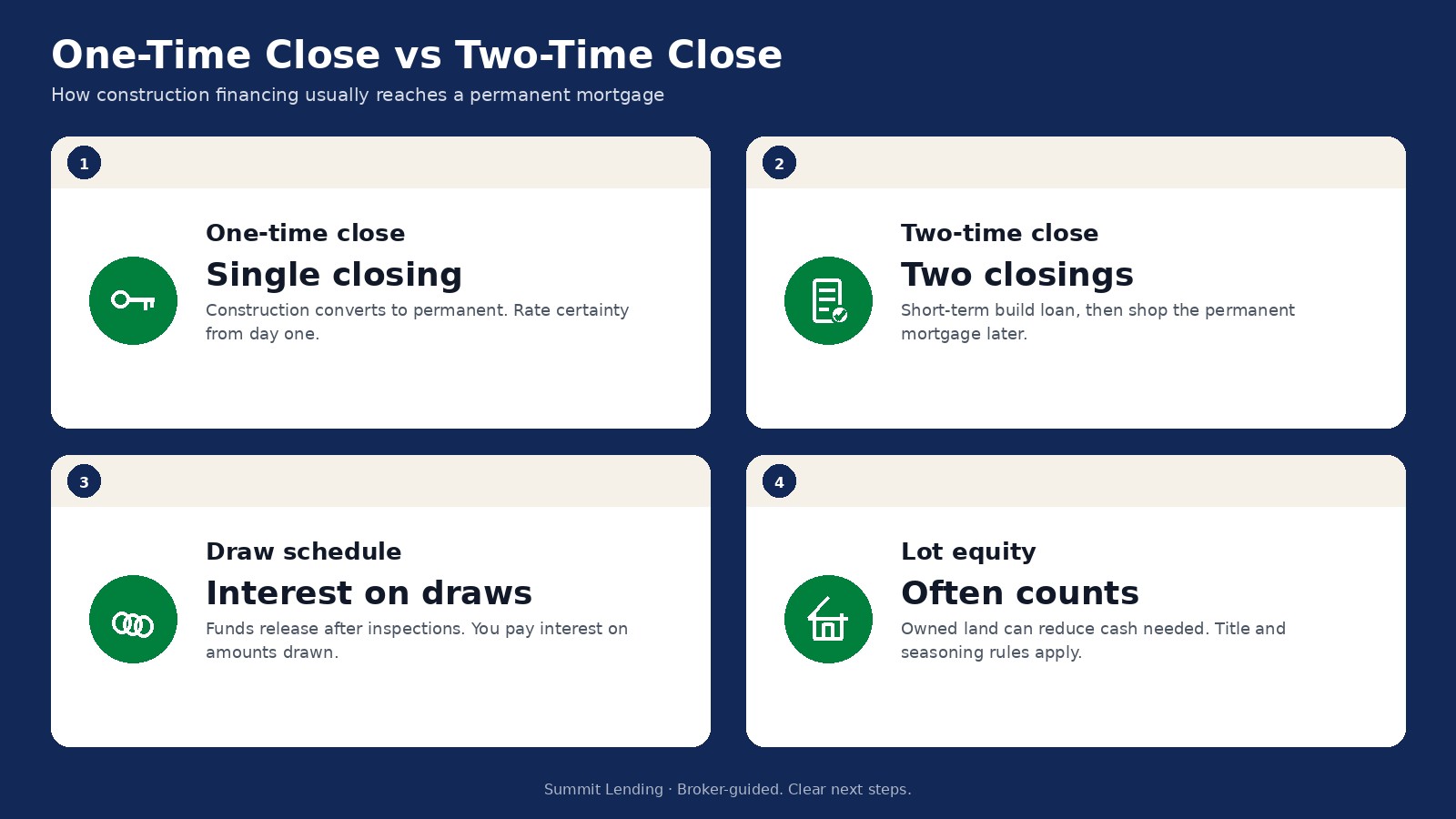
One-time close (construction-to-permanent) uses one approval and one closing. During the build you typically pay interest only on amounts drawn. When the home is finished, the loan converts to your permanent mortgage. The tradeoff is rate and program certainty early, with less flexibility to shop later.
Two-time close uses a short-term construction loan, then a separate permanent mortgage with a second closing and a second qualification. That can help if you want to shop the permanent loan when the house is done, but you take two sets of closing costs and the risk that permanent rates or your credit picture change mid-build.
How draws and budgets work
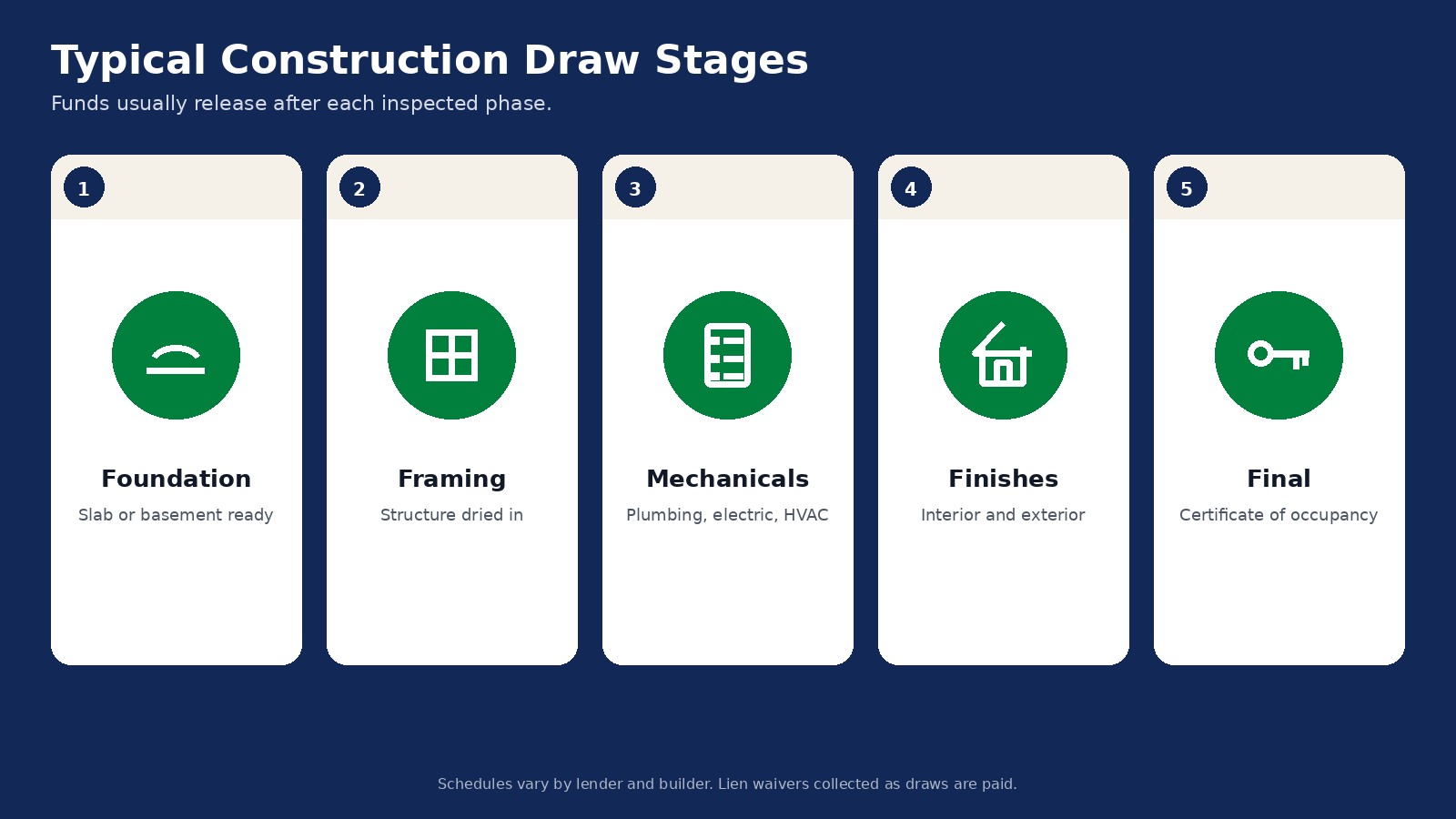
Construction funds release in stages after inspections, often roughly foundation, framing, mechanicals, finishes, and final. Most loans charge interest only on what has been drawn so far. Lenders and title companies also collect lien waivers as contractors are paid. A realistic budget with contingency is not optional. Change orders that blow past contingency are one of the fastest ways a build gets stuck.
If you already own the lot, that equity can often count toward your contribution, depending on seasoning and title. If you still need to buy land, we look at whether the land purchase and construction should be structured together or in steps.
Market context for builders and owner-builders
Texas remains one of the most active single-family permitting states. NAHB's reading of Census data showed Texas issued 87,795 single-family permits through July 2026, still the most of any state even with a modest year-over-year decline. The Texas Real Estate Research Center put the statewide median sales price at $339,000 in July 2026. Utah Association of REALTORS reported a $525,000 August 2026 statewide median with about 17,274 homes in inventory. Those figures shape both resale comps and what appraisers will support on a new build.
Construction loan pricing is not the same as the Freddie Mac purchase survey. The 30-year fixed survey average was 7.28% for the week of October 1, 2026. Use that as background for the permanent mortgage conversation, not as a construction quote.
State construction guides
- Utah construction loans, including Salt Lake County and Utah County
- Texas construction loans, including Harris County, Travis County, Dallas County, Tarrant County, and Bexar County
- Idaho construction loans, including Ada County and Canyon County
Owner-occupants often start with a preapproval discussion even on a build, because the permanent loan still has to fit income and credit. Buying a finished home instead? See purchase loans.


What to bring to the first construction call
- Lot details or purchase contract, including any existing liens
- Builder name, experience, and whether they are already approved with common construction lenders
- Plans, specs, and a line-item budget with contingency
- Your target permanent payment and how much cash you can contribute
- Timeline from groundbreaking to move-in
Related reading: mortgage loans overview, refinance if you will sell or refinance another property to fund the build, and commercial loans for non-owner-occupied or business-use projects.
Builder approval and contingency discipline
Many construction programs require the builder to meet experience, insurance, and financial standards before the first draw. A talented local carpenter who has never carried a construction loan may need a different structure than a production builder with an established lender list. We say that early so you are not redesigning the deal after permits are pulled.
Budgets should include contingency for materials and labor. When lumber, cabinets, or site work jump mid-project, the draw schedule has to absorb it or you write a check. Underwriters notice thin contingencies. So should you.
Owner-builder and renovation hybrids
Acting as your own general contractor is possible in some programs and impossible in others. Renovation that mixes new square footage with work on an existing homestead can trigger extra state rules, especially in Texas. If your project is mostly remodeling an existing home, tell us before we assume a clean ground-up construction box. Related consumer paths still live on purchase and refinance when the better answer is buying finished or refinancing after the work.
Permanent loan handoff
The end of a construction loan is not automatic magic. Occupancy certificates, final inspections, final draws, and final title updates have to line up before the permanent mortgage is clean. On a one-time close, that handoff is built into the original approval. On a two-time close, you still need to qualify again and close a second time. We plan that calendar with you at the start, not the week drywall finishes.
Information on this page is for general education. It is not a commitment to lend. Loan availability, terms, and pricing depend on your credit, income, assets, property, and lender overlays. Summit Lending LLC, NMLS 2394434.