
Utah Reverse Mortgages


Reverse mortgages in Utah: how a HECM works and who it fits
A reverse mortgage lets a homeowner 62 or older turn part of their home equity into cash without making a monthly mortgage payment. It can be a useful tool for retirees in Utah who have built equity over decades, but it is also a loan with real costs and ongoing obligations, and the balance grows over time. Summit Lending LLC (NMLS 2394434) is a Utah-based mortgage broker in Garland. We explain the federal rules in plain language, compare options with you, and make sure you and your family understand the trade-offs before you apply.
Most reverse mortgages in the United States are Home Equity Conversion Mortgages, or HECMs, insured by the Federal Housing Administration. This page focuses on HECMs and uses the 2026 federal limits.
Summit Lending LLC, NMLS 2394434, is based at 4542 W 14800 N, Garland, UT 84312 and serves borrowers in Utah, Texas, Idaho, Wyoming, Arkansas, and Arizona. Call 385-200-1470 or email [email protected].
The basics
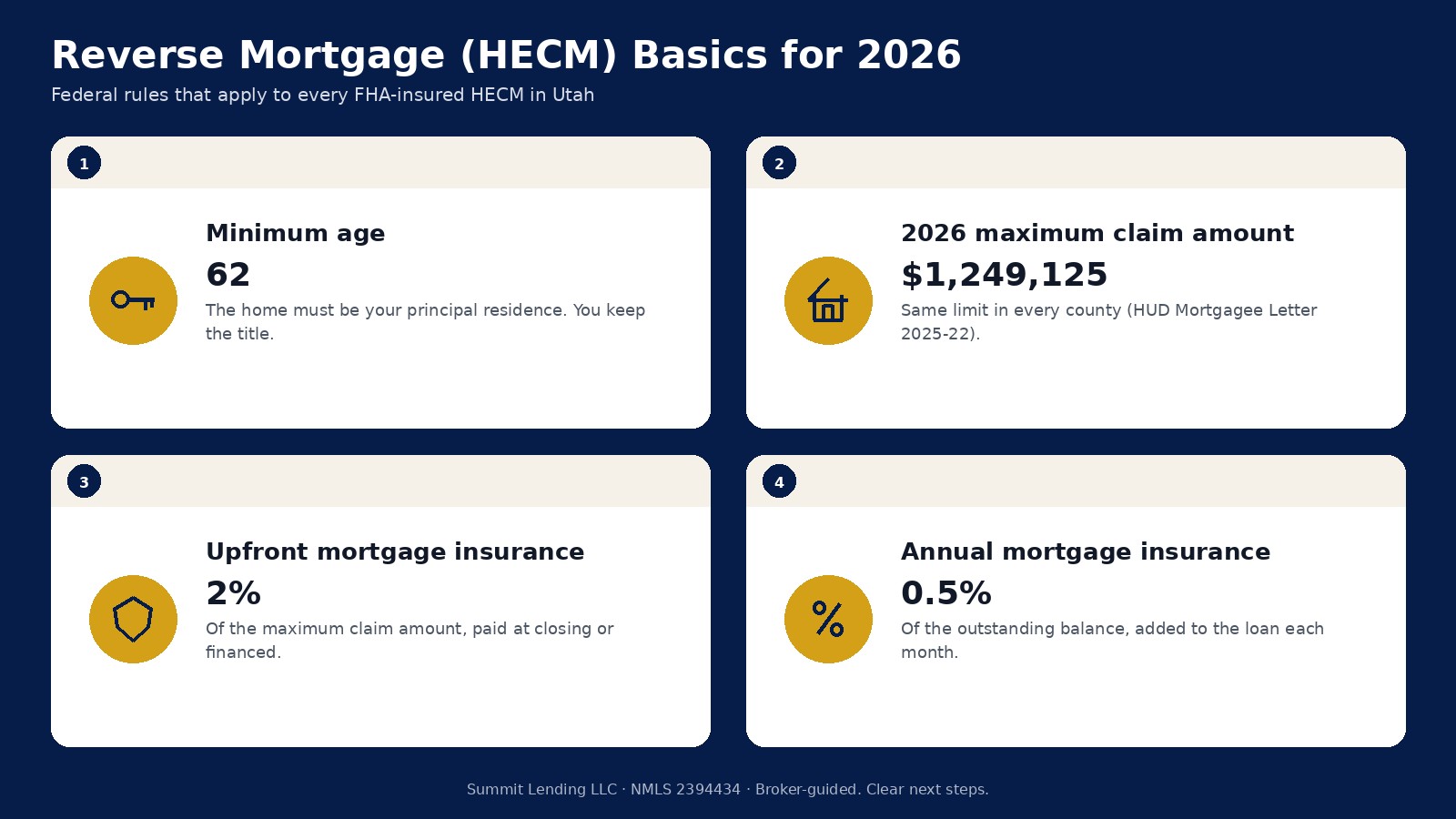
- Age and occupancy. At least one borrower must be 62 or older, and the home must be your principal residence (CFPB on reverse mortgages).
- No monthly mortgage payment. You do not make monthly principal and interest payments. Interest and mortgage insurance are added to the balance instead, so the amount you owe grows over time.
- You keep the title. You still own the home, and you are still responsible for property taxes, homeowners insurance, HOA dues, and upkeep. Falling behind on those can put the loan in default (CFPB).
- When it is repaid. The loan usually comes due when the last borrower sells, moves out permanently, or passes away. The home can be sold to repay it, or heirs can pay it off.
2026 HECM limits and insurance costs
For 2026, the HECM maximum claim amount is $1,249,125 nationwide, up from $1,209,750 in 2025 (HUD Mortgagee Letter 2025-22). The maximum claim amount is the lower of your home's appraised value or that limit, and it is the base for the upfront insurance premium.
FHA charges an upfront mortgage insurance premium of 2% of the maximum claim amount and an annual premium of 0.5% of the outstanding balance (HUD Mortgagee Letter 2017-12). On a Utah home appraised at $600,000, the upfront premium would be about $12,000. For a home appraised above the limit, say in Park City or Summit County, the premium is capped at 2% of $1,249,125, or about $24,982. Those premiums are usually financed into the loan along with other closing costs.
How much you can actually receive depends on the age of the youngest borrower (or eligible non-borrowing spouse), the expected interest rate, and the maximum claim amount. Older borrowers and lower rates generally mean more available proceeds. We run the numbers with you before anything is ordered.

How you can take the money
Federal HECM rules set out the payment options (24 CFR 206, Subpart B). Which ones you can use depends on whether you pick a fixed or an adjustable rate:
- Term. Equal monthly payments for a fixed number of months you choose.
- Tenure. Equal monthly payments for as long as the loan stays in good standing and you live in the home.
- Line of credit. You draw money when you want it, in the amounts you choose, up to your available limit.
- Modified term or modified tenure. Monthly payments combined with a line of credit.
- Single lump sum. One payment at closing. This is the only option for a fixed-rate HECM.
Any existing mortgage on the home must be paid off from the proceeds first. If the home needs required repairs after closing, the lender sets aside 150% of the estimated repair cost. If the financial assessment shows a risk that taxes or insurance could go unpaid, the lender can set aside part of your available funds, called a Life Expectancy Set Aside, to pay property taxes and hazard and flood insurance for you (24 CFR 206.19). That lowers the cash you can take, but it protects against default.
What families should understand
The CFPB puts it simply: a reverse mortgage is not free money. Interest and fees are added each month, so the balance rises while your equity falls, and the loan is usually repaid by selling the home once the last borrower no longer lives there (CFPB). Any equity left after the loan is repaid belongs to you or your heirs. Ask us, and your counselor, how repayment works for heirs who want to keep the home. We encourage borrowers to bring adult children or a trusted advisor to the counseling session and to our conversations.
The CFPB also warns about scams. Be wary of contractors who suggest a reverse mortgage to pay for repairs they are selling, and of ads that claim VA approval or promise veterans special reverse mortgage deals (CFPB warnings). A legitimate HECM always starts with independent counseling.
How a Utah reverse mortgage moves
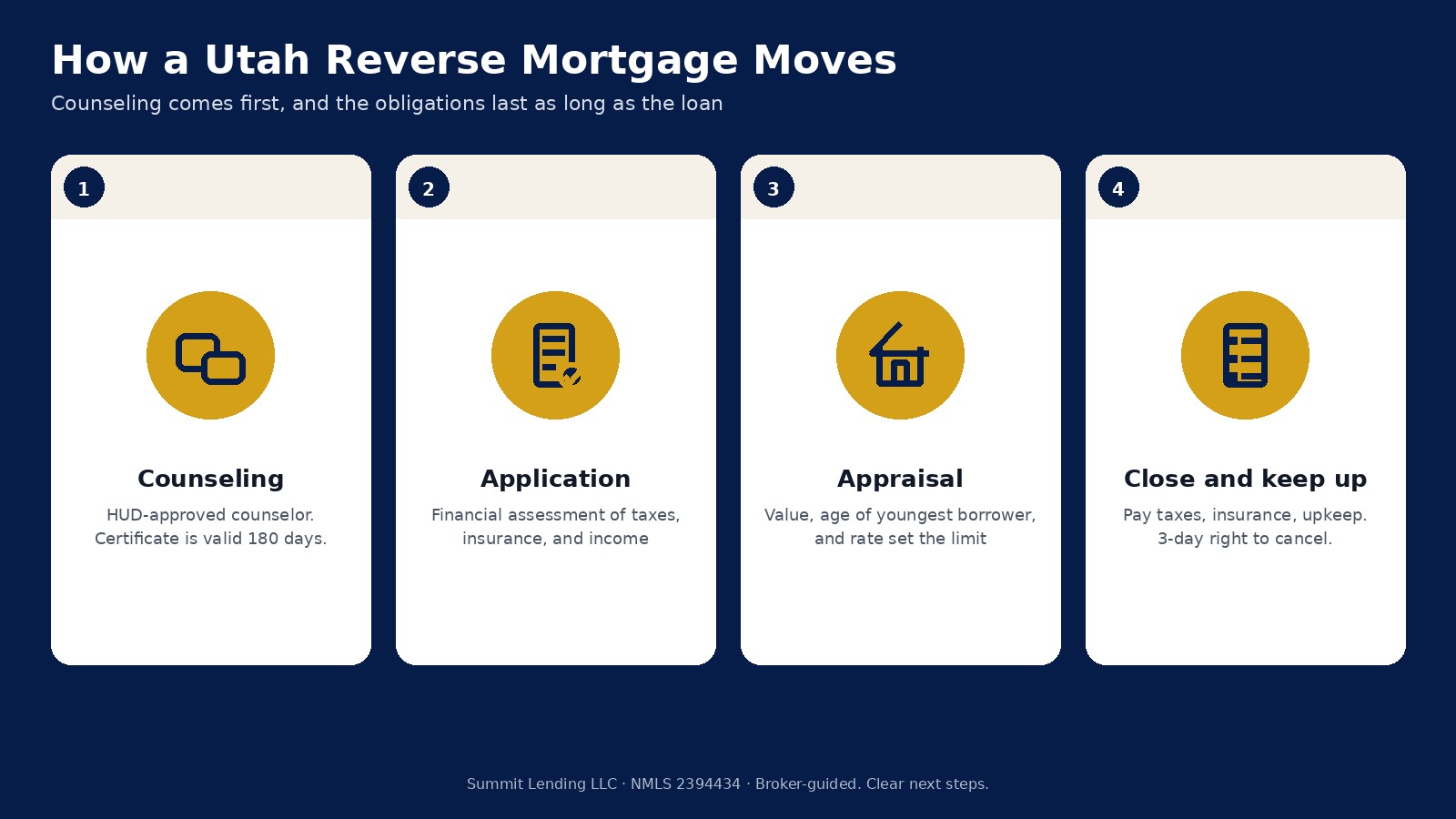
- Counseling. Before you can apply, you meet with a HUD-approved HECM counselor who is independent of the lender. The counseling certificate is generally valid for 180 days (HUD HECM overview; find counselors through HUD housing counseling).
- Application and financial assessment. The lender reviews your credit history, income, and whether you can keep paying taxes and insurance. If the review shows a risk, the lender may require a set aside, as described above.
- Appraisal. An FHA appraisal sets the home's value, which together with the youngest borrower's age and the rate determines how much is available.
- Closing and the right to cancel. For most reverse mortgages you have three business days after closing to cancel (CFPB). After that, you keep up with taxes, insurance, and maintenance for the life of the loan.
Utah details to know
- Property tax is still yours. Your home keeps Utah's 45% primary residential exemption as long as it remains your primary residence (Utah State Tax Commission), but the remaining tax bill must be paid every year, either by you or from a set-aside.
- Insurance. Homeowners insurance must stay in force. If your home is in a flood zone, flood insurance is required too.
- Condos and HOAs. Condos must meet FHA requirements, and HOA dues still need to be paid.
- Veterans. The VA does not offer reverse mortgages. Veterans who want one would use a HECM or a private product.
Is a reverse mortgage right for you?
A reverse mortgage can make sense if you plan to stay in your home for many years, have significant equity, and want to reduce monthly costs or add a financial cushion. It may not be the best fit if you expect to move soon, want to leave the full value of the home to heirs, or would struggle to keep paying taxes and insurance. Alternatives include downsizing, a traditional Utah refinance, or a home equity loan. The CFPB encourages borrowers to compare options and understand the costs before committing (CFPB guide).
Where we help Utah homeowners
Along the Wasatch Front: Salt Lake City, West Jordan, Provo, Orem, Lehi, Ogden, Layton, Salt Lake County, Utah County, Davis County, and Weber County. Northern and rural Utah: Brigham City, Tremonton, Garland, Box Elder County, and Cache County. Elsewhere: Park City, Summit County, and Washington County.
Related pages
See Idaho reverse mortgages, Wyoming reverse mortgages, and Texas reverse mortgages, or the national reverse mortgage page. For Utah, the Utah mortgage overview, Utah mortgage calculator, and Utah purchase loans cover the rest.
Sources
- CFPB, What is a reverse mortgage?
- HUD Mortgagee Letter 2025-22, 2026 HECM limits (PDF)
- HUD Mortgagee Letter 2017-12, HECM premiums (PDF)
- HUD HECM origination and servicing overview (PDF)
- 24 CFR Part 206, Subpart B, HECM eligibility and payment options (PDF)
- HUD housing counseling
- Utah State Tax Commission, primary residential exemption
- Freddie Mac Primary Mortgage Market Survey
Information on this page is for general education and is current as of October 2026. It is not a commitment to lend or a rate quote. Program rules, limits, and availability change, and approval depends on your credit, income, assets, property, and lender guidelines. Summit Lending LLC, NMLS 2394434. Equal Housing Opportunity.